
LAVA Part of $2.4 Million DOE Project to Advance Secure and Trustworthy AI for the Nation’s Power Grid


LAVA will lead the development of AI-assisted visualization and decision-support technologies that help grid operators understand complex data, emerging threats, and AI recommendations
HONOLULU, September 1, 2026 — The University of Hawaiʻi at Mānoa has received $718,834 as part of a $2.4 million U.S. Department of Energy EPSCoR award to develop secure and trustworthy artificial intelligence technologies for the nation’s electrical grid.
The project, GRID-AIR: Secure and Trustworthy Artificial Intelligence for Smart Grid Applications (Award No. DE-SC0026398), brings together researchers from the University of Maine, UH Mānoa, the University of North Dakota, and the University of Puerto Rico Mayagüez. The collaboration will investigate how artificial intelligence can improve the reliability and resilience of power systems while protecting them from cyberattacks, corrupted data, compromised AI models, and hardware vulnerabilities.
Within the UH effort, the Laboratory for Advanced Visualization & Applications (LAVA) will lead the development of advanced visualization and human–AI collaboration tools for future grid control environments. The work will help operators, engineers, and emergency managers interpret large volumes of sensor, weather, energy, and cybersecurity data and understand how AI systems reach their conclusions.
“Artificial intelligence can help operators detect threats, forecast demand, and respond to disruptions much faster, but speed alone is not enough,” said Jason Leigh, director of LAVA and professor of Information and Computer Sciences at UH Mānoa. “Operators must be able to understand what the AI believes is happening, why it is recommending a particular action, how confident it is, and what could happen next. LAVA’s role is to make that complex interaction visible, understandable, and actionable.”
LAVA will build upon SAGE3, its open-source platform for collaborative data visualization and AI-assisted analysis. SAGE3 allows teams to examine and discuss information together across devices ranging from laptops to large display walls. The GRID-AIR project will extend this environment to support grid operators who need to monitor changing system conditions, investigate anomalies, evaluate AI-generated recommendations, and coordinate responses to potential cyberattacks or power disruptions.
LAVA’s research will emphasize keeping people actively involved in consequential decisions. Instead of treating AI as an autonomous replacement for grid operators, GRID-AIR will explore how AI can serve as a transparent partner that identifies unusual conditions, explains possible threats, presents alternatives, and helps people anticipate the consequences of different actions.
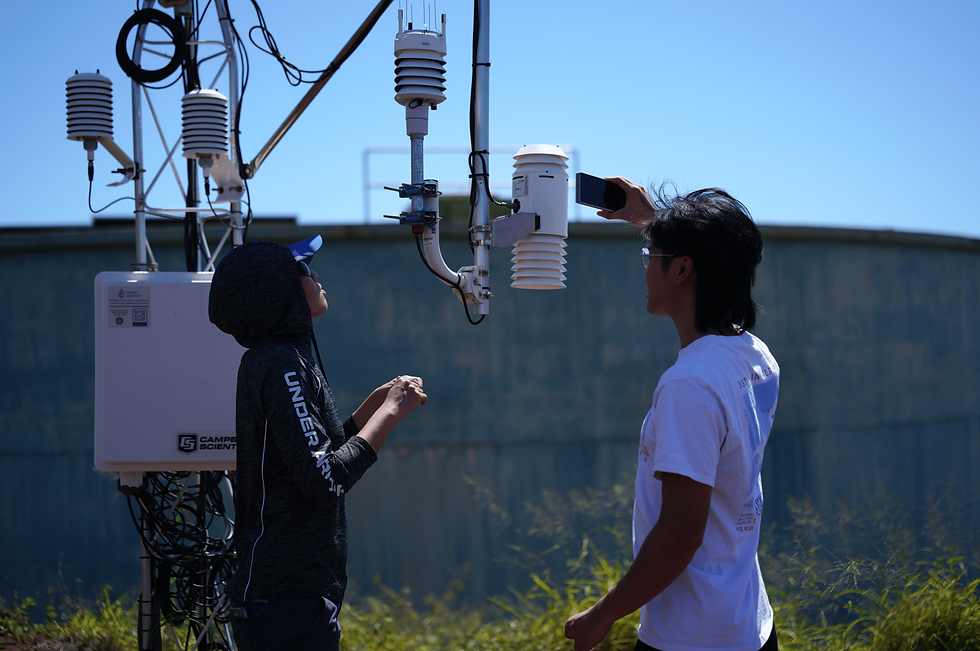
UH Mānoa will also serve as a living laboratory for the project. Researchers will build upon approximately 165 electrical meters and multiple photovoltaic systems across the campus, adding secure, higher-resolution data collection and streaming capabilities. UH experts will use these data to develop AI models for forecasting renewable-energy generation and electricity demand, detecting equipment problems, and distinguishing natural anomalies from malicious manipulation.
The Hawaiʻi team will draw upon the university’s existing cyberinfrastructure, climate-data, machine-learning, energy-management, visualization, and energy-economics capabilities. Researchers will also examine the costs, benefits, and equity implications of AI-enhanced grid security, including how investments and potential pricing changes may affect different households and communities.
Hawaiʻi provides an important setting for this research. Its isolated electrical grid, high reliance on imported energy, expanding use of renewable resources, and exposure to hurricanes, wildfires, flooding, and other extreme events make resilience especially critical. Cyberattacks occurring during a natural disaster could complicate emergency response, prolong outages, and endanger vulnerable communities.
Across the four participating states and territories, GRID-AIR will create a connected experimental environment that combines live sensors, edge-computing systems, AI models, and digital and physical microgrid twins. The researchers will test the system against data poisoning, model manipulation, denial-of-service attacks, signal spoofing, malware, equipment failures, and extreme operating conditions. The goal is to create AI systems capable of detecting attacks, isolating compromised components, explaining their decisions, and safely restoring grid operations.
The project will also support undergraduate and graduate researchers, postdoctoral scholars, and early-career faculty while developing cybersecurity and smart-grid training materials that can be incorporated into university and high-school education.
Ultimately, GRID-AIR aims to provide utilities and grid operators with a comprehensive framework for deploying AI safely—from the sensors collecting the data to the hardware running the models and the human operators making the final decisions.

Comments